Garrett W. Merz
Scientist · UW–Madison Physics & Data Science Institute

Garrett W. Merz

learning representations of the physical world

    ATLAS Open Data · run 300908 · event 1315251030 · √s = 13 TeV, 2016 · tt̄H(→γγ) semileptonic candidate · mγγ = 126.9 GeV · about this homepage
    Click a physics object to navigate

    Ongoing Work

    • AI for Scattering Amplitudes

      Learning the symbols of amplitudes in planar N=4 super Yang–Mills theory

      with K. Cranmer, L. Dixon, F. Charton, M. Wilhelm, J. Pages, H. Cao
    • Foundation Models for High-Energy and Nuclear Physics

      Self-supervised learning across detectors and energy scales

      with M. Pettee, S. Joosten, M. Zuzek, M. Cremonesi, M. Paulini, R. Fatemi, W. Korsch
    • Foundation Models and Information Theory

      Information-theoretic foundations of self-supervised learning

      with R.K.Hashmani, M. Pettee, H. Qu, K. Cranmer
    • World Models and Scientific Data

      Joint Embedding Predictive Architectures for real-world scientific data

      with O. Altindag, R. Balaestriero, A. Soubki, M. Cranmer, M. Pettee, H. Qu

    Earlier

    On ATLAS, I played a central role in the first observation of top-associated Higgs production (tt̄H) and the CP measurement of the top–Higgs coupling in the diphoton channel.

    As a Research Scientist at Intelinair, I built self-supervised vision transformers for gigapixel hyperspectral remote sensing imagery for precision agriculture.
    Selected · full list on ORCID

    • 2026
      Reconstructing conformal field theoretical compositions with Transformers
      H. Cao, G. W. Merz, K. Cranmer, G. Shiu
      Machine Learning: Science and Technology (under review) · arXiv:2605.01072
    • 2025
      Multimodal datasets with controllable mutual information
      R. K. Hashmani, G. W. Merz, H. Qu, M. Pettee, K. Cranmer
      ICLR 2026 Workshop on Foundation Models for Science · arXiv:2510.21686
    • 2025
      Self-supervised learning strategies for jet physics
      P. Rieck, K. Cranmer, E. Dreyer, E. Gross, N. Kakati, D. Kobylianskii, G. W. Merz, N. Soybelman
      Mach. Learn.: Sci. Technol. 6, 045015 · 10.1088/2632-2153/ae1100
    • 2025
      Recurrent features of amplitudes in planar N=4 super Yang–Mills theory
      T. Cai, F. Charton, K. Cranmer, L. J. Dixon, G. W. Merz, M. Wilhelm
      JHEP 2025, 143 · 10.1007/JHEP04(2025)143
    • 2024
      Transforming the bootstrap: using transformers to compute scattering amplitudes in planar super Yang–Mills theory
      T. Cai, G. W. Merz, F. Charton, N. Nolte, M. Wilhelm, K. Cranmer, L. J. Dixon
      Mach. Learn.: Sci. Technol. 5, 035073 · 10.1088/2632-2153/ad743e
    • 2020
      CP properties of Higgs boson interactions with top quarks in the tt̄H and tH processes using H → γγ
      ATLAS Collaboration
      Phys. Rev. Lett. 125, 061802 · 10.1103/PhysRevLett.125.061802
    • 2018
      Observation of Higgs boson production in association with a top quark pair at the LHC
      ATLAS Collaboration
      Phys. Lett. B 784, 173 · 10.1016/j.physletb.2018.07.035

    Community

    • 2025 – 2026Organizing Committee, NeurIPS Machine Learning for the Physical Sciences workshop (Area Chair, 2025, 2026)
    • 2023 – 2026APS Group on Data Science, Executive Committee (early-career member at large); Industry Advisory Board
    • Aug 2025Co-chair, Computing & AI/ML session, 32nd Lepton Photon Symposium
    • OngoingReviewer for PRX-Intelligence, JHEP, MLST, PAI, Physica Scripta, JOSS, NeurIPS ML4PS, CVPR Agriculture-Vision

    Teaching & outreach

    • 2025 – 2026Section lead, AI + Physics, UW–Madison PEOPLE precollege program
    • 2018Science Communication Fellow, University of Michigan Museum of Natural History
    • 2016 – 2021Center for Academic Innovation VR/XR grant pilot, University of Michigan
    • 2016 – 2017Graduate Student Instructor, Physics 136 (Life Sciences Lab I)

    This is my blog, which covers science, technology, art, and organizing for a better world.

    In print & manuscript studies, “ephemera” is used to describe everyday miscellany (newspapers, ticket-stubs, postcards) that are not originally meant to be preserved, but that are of interest to collectors and historians. This space is intended for creative projects, things I find interesting, a list of things I am reading, etc.

    The Pliny Project
    Pliny the Elder's 'Historia Naturalis' and Modern Science
    COMING SOON
    The Book of Epochs
    A Deep Time Book of Hours
    COMING SOON
    Physics for Poets, Revisited
    A Generative Poetry Workshop × Physics Lab
    COMING SOON
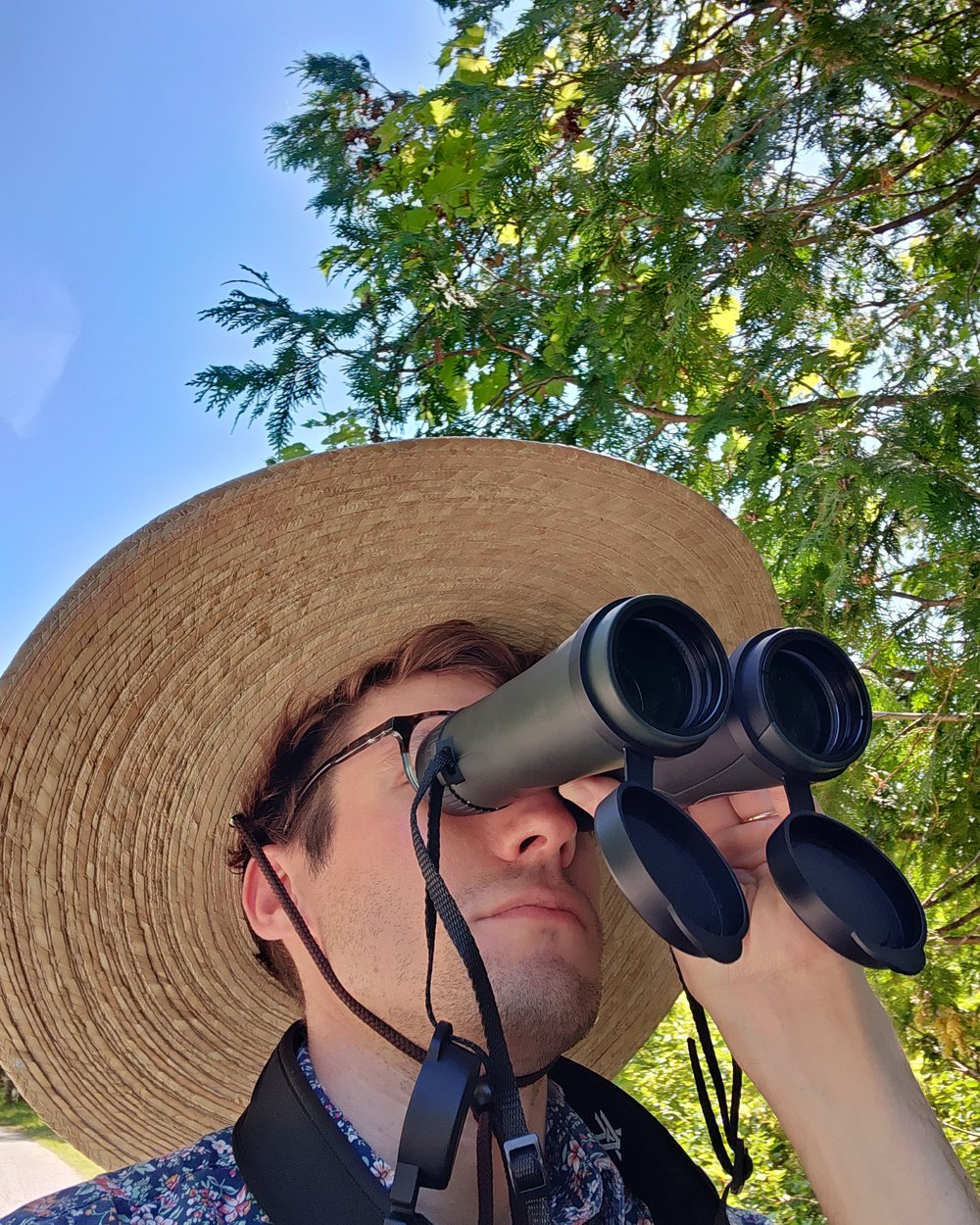
    Garrett Merz in a wide-brimmed straw hat, looking up through binoculars beneath summer trees.
    June 2025

    I'm a physicist and computer scientist at the University of Wisconsin–Madison. My research interests center on representation learning, often (but not always) for the physical sciences. I also spend a lot of time thinking about intersections of physics and computing and the humanities, especially those related to intersections between scientific ways of noticing the world and creative ones.

    When I'm not building models I enjoy gardening, playing the banjo, announcing my friends' roller derby bouts, cryptic crosswords, and hanging out with my partner, the poet A.M. Goodhart, and Molly Grue, our horrible, no-good, very bad dog.

    Ph.D. Physics, Michigan 2021 · B.S. Physics & Mathematics, Ohio State 2016 · NSF GRFP 2018

    This is a real high-energy physics event that was produced inside the ATLAS detector at CERN's Large Hadron Collider (LHC) in 2016. When protons collide, their constituent particles (quarks and gluons) often interact to make new particles, such as photons or Higgs bosons. Most of the particles produced in this way are unstable, meaning that they decay into other particles some of these produce firework-like sprays of lower-energy particles, which are captured as “hits” (represented as points) in the ATLAS detector's calorimeter sensors. This is a candidate ttH (top associated Higgs production) event (there is no way to know for sure if it is actually a ttH event, or another "background" event with an identical decay signature!). If it is in fact a ttH event, it consists of a Higgs boson (which decays into two photons) and two top quarks (one of which decays into a bottom quark jet, a muon, and an invisible neutrino (denoted ETmiss); the other of which decays into a bottom-quark jet and two light-quark jets (not highlighted). A significant portion of my research involves training neural networks to reconstruct the “truth-level” physics from calorimeter hits. Neural networks learn representations of high-dimensional data, compressing data such as calorimeter clusters or images into fixed-size vectors. Building good representations of physics data will likely be critical for the upcoming high-luminosity LHC upgrade, after which there are projected to be ~200,000 calorimeter hits per event, roughly 100× more than in the event shown here.

    This website was built with the help of Claude Code. In future iterations, I plan to rework or rewrite it using an open-source code LLM, such as Qwen Code.

    Email
    garrettwmerz@gmail.com
    Curriculum vitae
    Location
    Madison, Wisconsin